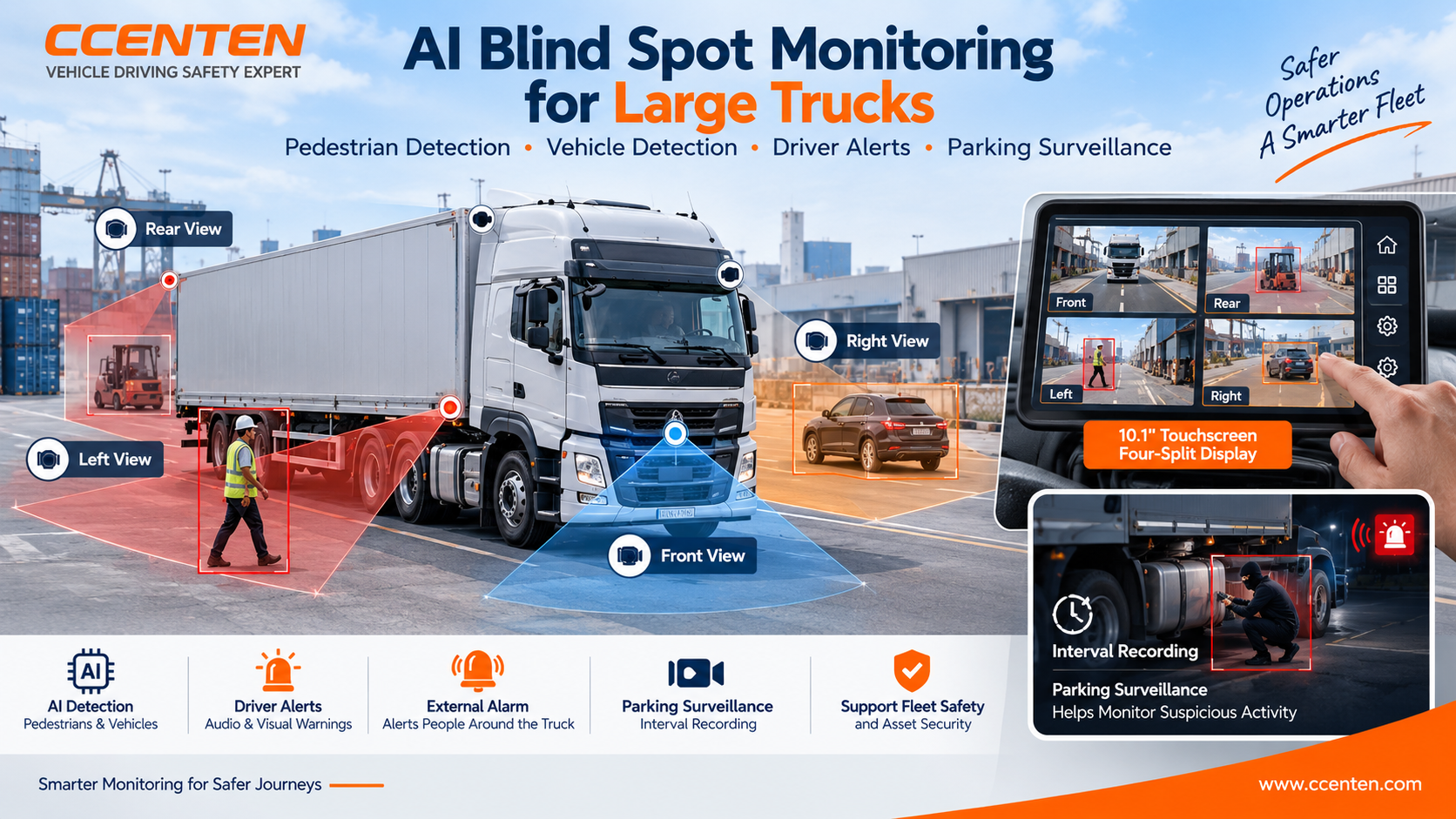
Large trucks operate in environments where pedestrians, motorcycles, passenger cars, and other vehicles may move close to the vehicle body. Because of the truck’s size and structure, some areas around the vehicle may be difficult for the driver to observe through mirrors or direct vision.
A full-vehicle blind spot monitoring system can provide additional visibility around the truck. By combining multiple cameras, AI detection, a touchscreen monitor, and warning devices, the system helps drivers pay attention to potential hazards during driving, turning, reversing, loading, unloading, and parking.
In addition to road safety, this type of system may also support parking surveillance and suspicious activity monitoring when the vehicle is unattended.
Why Large Trucks Need Full-Vehicle Blind Spot Monitoring
Large trucks have long bodies, high driving positions, wide turning areas, and multiple blind zones. These blind zones may change according to the vehicle’s size, body structure, trailer length, camera position, and driving maneuver.
Potentially difficult-to-observe areas may include:
- The area directly in front of the truck
- The area behind the truck or trailer
- The left side of the vehicle
- The right side of the vehicle
- The areas beside the front and rear wheels
- The side areas near loading and unloading points
- The rear area during reversing and parking
A driver may not immediately notice a pedestrian or vehicle entering one of these areas. A full-vehicle monitoring system provides an additional visual reference and can generate warnings when relevant objects are detected.
Four-Direction Camera Coverage
A full-vehicle blind spot monitoring system generally uses four camera positions to monitor the main areas around the truck:
| Camera Position | Monitoring Purpose |
|---|---|
| Front Camera | Monitors the area in front of the truck during forward movement and low-speed maneuvering. |
| Rear Camera | Monitors the area behind the truck during reversing, parking, and vehicle movement in confined spaces. |
| Left Camera | Monitors the left-side blind zone for nearby pedestrians, motorcycles, cars, and other vehicles. |
| Right Camera | Monitors the right-side blind zone and supports awareness during turning and side movement. |
The four camera views can be displayed together, allowing the driver to check several surrounding areas without manually switching between individual cameras.
The actual coverage area depends on the camera lens, mounting height, installation angle, vehicle dimensions, and surrounding environment. Camera installation should therefore be designed according to the specific truck model and operating requirements.
AI Detection of Pedestrians and Vehicles
Conventional camera systems mainly provide video images. An AI-enabled blind spot monitoring system can go further by analyzing the images and identifying objects within the monitored areas.
Pedestrian Detection
Pedestrian detection is particularly useful in locations where people and large trucks operate close to each other.
Typical application areas include:
- Logistics centers
- Warehouses
- Loading docks
- Construction sites
- Ports and terminals
- Industrial facilities
- Urban delivery areas
- Truck parking areas
When a person enters a monitored blind zone, the system may generate a visual or audio warning to attract the driver’s attention. This can provide additional support when the driver is turning, reversing, starting from a stop, or moving through a crowded working area.
Vehicle Detection
The system may also detect vehicles approaching or entering the monitored areas. Depending on the supported AI algorithm and configuration, the detection targets may include passenger cars, motorcycles, electric bicycles, trucks, and other vehicles.
Vehicle detection can be useful during:
- Lane changes
- Turning at intersections
- Reversing
- Entering or leaving a loading area
- Passing through narrow roads
- Operating in busy logistics yards
- Moving around construction equipment
Recognition distance and detection performance may be affected by lighting, weather, object size, camera position, vehicle speed, road conditions, and other environmental factors.
Touchscreen Four-Split Display
A full-vehicle blind spot monitoring system may use a large touchscreen monitor to display the front, rear, left, and right camera feeds simultaneously.
A four-split display can help the driver understand the surrounding vehicle environment more quickly. The touchscreen interface may also allow the user to select a camera view, switch display layouts, enlarge an image, or adjust supported settings.
Common functions of a touchscreen monitoring display may include:
- Simultaneous display of four camera views
- Individual camera view selection
- Display layout switching
- Image enlargement
- Touch-based system operation
- Visual display of detection or warning information
The monitor should be installed within a suitable viewing area and should not create unnecessary distraction. The driver must continue to observe the road, mirrors, traffic signs, and surrounding conditions.
Driver Warning and External Alarm Functions
A key function of an intelligent BSD system is to provide warnings when a pedestrian or vehicle is detected in a monitored blind zone.
Driver Warning
Warnings inside the cabin may include visual indicators, audio alerts, highlighted detection areas, or other supported notification methods.
For example, when a pedestrian is detected beside the truck, the system may display the corresponding camera view and issue an alert. The driver can then check the surrounding conditions and take appropriate action.
Warning rules may be configured according to the camera area, object type, vehicle status, speed, or project requirements, depending on the system design.
External Warning Device
In some applications, an external alarm can be installed on the outside of the truck. When a pedestrian or vehicle approaches a monitored area, the external device may produce a sound or light warning.
This function is useful because people near the truck may not be able to see the driver’s monitor. An external alarm can help attract their attention and communicate that a large vehicle is operating nearby.
External warning devices may be useful in:
- Loading and unloading areas
- Construction sites
- Warehouses
- Industrial yards
- Ports and terminals
- Truck parking areas
The alarm volume, installation position, and warning logic should be selected according to the working environment. Excessive or unnecessary alarms may cause distraction or alarm fatigue, so the system should be configured carefully.
Parking Surveillance and Interval Recording
Blind spot monitoring is not limited to active driving. Some systems also support parking surveillance through interval recording, also known as time-lapse or periodic recording.
With interval recording, the system captures images or recording segments at a defined time interval instead of recording continuously at the same frame rate. When configured for one-second intervals, the system may capture one image or recording segment approximately every second.
This function can help operators review activity around a parked truck after the driver has left the vehicle.
Potential applications include:
- Monitoring activity around a parked truck
- Reviewing suspicious movement near the fuel tank
- Checking activity near vehicle doors or storage areas
- Supporting investigation of suspected fuel theft
- Reviewing loading and unloading activity
- Monitoring unattended vehicles at night
Interval recording is a video surveillance function. It should not be considered a replacement for a dedicated fuel-level sensor, fuel management system, or professional anti-theft solution.
Supporting Fuel Theft and Oil Theft Prevention
Fuel theft can create operational and financial losses for fleet operators, especially when trucks are parked overnight or left unattended in remote areas.
A vehicle monitoring system with parking surveillance may provide useful video evidence when suspicious activity occurs near the fuel tank or vehicle body.
For example, operators may combine interval recording with external alarms, door sensors, fuel-level sensors, GPS information, and remote video review.
A more complete fuel security configuration may include:
- Side-view and rear-view cameras
- Parking interval recording
- External sound or light alarms
- Fuel-level monitoring
- Vehicle door sensors
- GPS location information
- Remote video access
- Event-based alarm recording
The actual anti-theft function depends on the connected sensors, alarm inputs, recording mode, parking status, and software configuration. Camera monitoring can support investigation and warning, but it does not independently guarantee that fuel theft will be prevented.
Applications for Different Types of Large Trucks
Logistics and Delivery Trucks
Logistics trucks frequently operate in warehouses, distribution centers, loading docks, and busy yards. Blind spot monitoring can help drivers observe nearby pedestrians and vehicles during reversing, loading, unloading, and low-speed movement.
Construction Trucks
Construction sites may contain workers, machinery, building materials, and changing traffic routes. A full-vehicle BSD system can provide additional visibility around heavy-duty trucks and construction vehicles.
Tank Trucks
Tank trucks may operate in industrial areas, fuel stations, chemical facilities, and restricted working zones. Surrounding camera monitoring and external warning devices can support safer movement in areas where people and vehicles operate close to the truck.
Heavy-Duty Transport Trucks
Heavy-duty transport trucks have large dimensions and may need additional monitoring during turning, reversing, and operation in narrow spaces. Four-direction camera coverage can help the driver understand the surrounding environment.
Mining and Industrial Vehicles
Mining and industrial vehicles may operate in areas with limited visibility, heavy equipment, and strict safety requirements. The system configuration should be adapted to the vehicle structure, working environment, lighting conditions, and required detection areas.
Important Selection Considerations
Before selecting a full-vehicle blind spot monitoring system, fleet operators should evaluate the following factors:
- Vehicle dimensions: Confirm the truck length, width, height, trailer structure, and blind zone locations.
- Camera coverage: Determine whether front, rear, left, and right monitoring is required.
- Detection targets: Confirm whether the system supports pedestrians, cars, motorcycles, bicycles, trucks, or other objects.
- Detection distance: Check the required monitoring range for the actual operating environment.
- Display size: Consider whether a four-split touchscreen display is suitable for the driver’s cabin.
- Warning methods: Confirm whether the system provides visual alerts, audio alerts, external alarms, or multiple warning methods.
- Parking monitoring: Determine whether interval recording or time-lapse recording is required.
- Fuel security: Check whether fuel sensors, door sensors, alarm inputs, or other anti-theft functions need to be integrated.
- Night performance: Consider low-light conditions, infrared support, image sensitivity, and glare.
- Environmental protection: Evaluate dust, water, vibration, temperature, and outdoor installation conditions.
- System integration: Confirm whether the BSD system needs to connect with a DVR, GPS platform, CMS platform, or other vehicle equipment.
- Installation: Verify camera mounting positions, cable routing, power supply, and maintenance requirements.
Full-Vehicle BSD and Vehicle Monitoring Solutions
A full-vehicle blind spot monitoring system combines camera coverage, AI object detection, driver alerts, touchscreen operation, and optional external warning functions.
For large trucks, this combination can support safer maneuvering in areas where pedestrians and vehicles operate close to the vehicle. When parking surveillance and interval recording are included, the system may also help operators review suspicious activity around unattended trucks.
The most suitable configuration depends on the truck structure, blind zone locations, detection requirements, parking environment, and fleet safety objectives.
CCENTEN provides vehicle monitoring solutions for commercial vehicles, including truck camera systems, AI safety functions, BSD blind spot monitoring, vehicle DVR systems, and related fleet monitoring technologies.
To explore additional vehicle monitoring applications and system configurations, visit Vehicle Monitoring Solutions.
Conclusion
Blind zones are an important safety consideration for large trucks because the vehicle’s size and structure can limit the driver’s direct visibility.
A full-vehicle BSD system with front, rear, left, and right cameras can provide additional surrounding visibility. AI detection of pedestrians and vehicles can support driver awareness, while a touchscreen four-split display allows multiple camera views to be checked in one interface.
External alarms may help warn people near the truck, and interval recording can support parking surveillance and suspicious activity review. When combined with suitable sensors and alarm inputs, these functions may contribute to a broader truck safety and security solution.
Fleet operators should select the system according to the vehicle structure, operating environment, required detection targets, camera coverage, warning methods, and parking security needs.